About
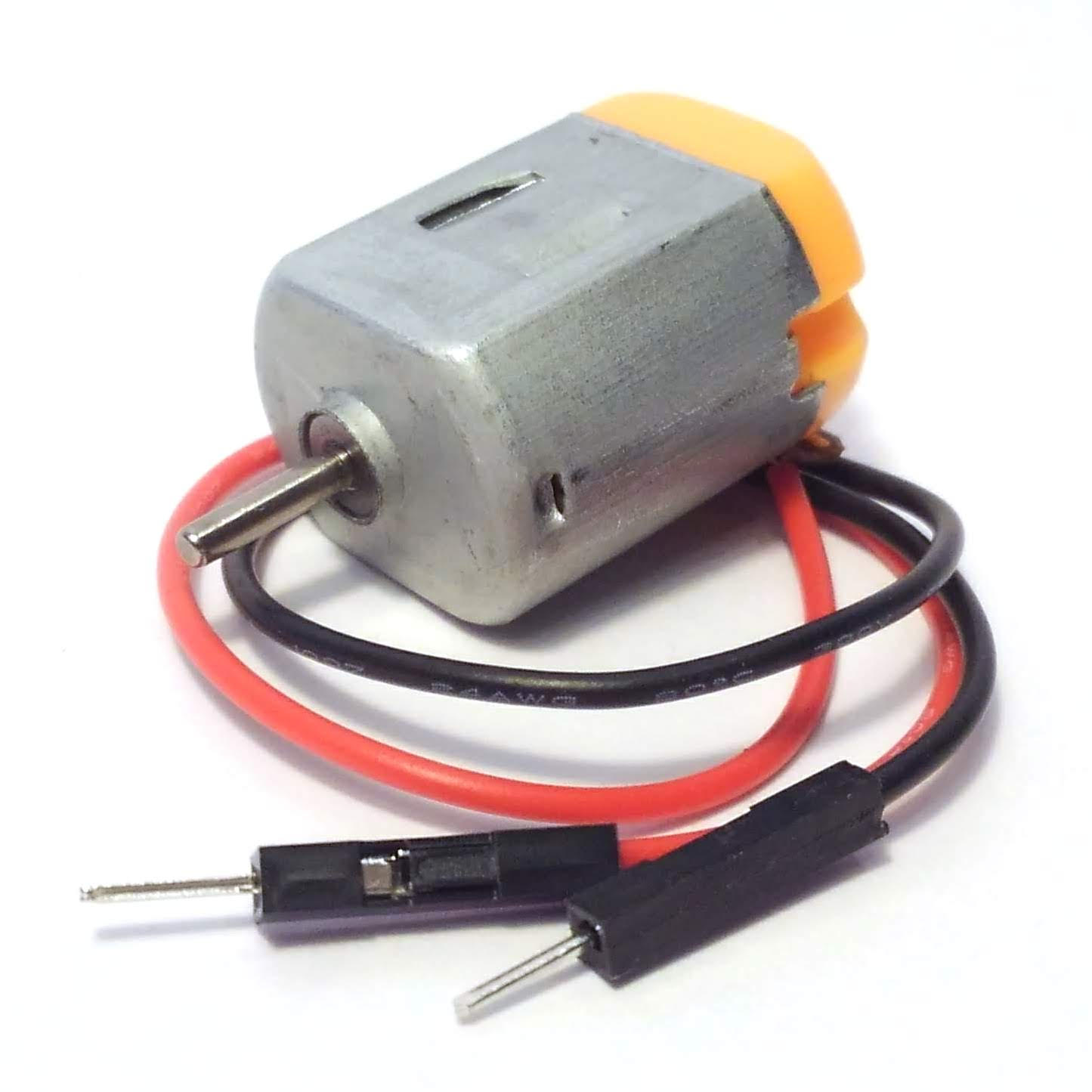
A DC motor converts direct current (DC) electrical energy into mechanical energy. The most common types rely on the forces produced by magnetic fields. Nearly all types of DC motors have some internal mechanism, either electromechanical or electronic, to periodically change the direction of current in part of the motor. (Adapted from Wikipedia)
When a DC motor is powered, a magnetic field is created in its stator (stationary part of the machine). The field attracts and repels magnets on the rotor (the, rotating part of the machine); this causes the rotor to rotate. (Adapted from iqsdirectory)
Getting started

What we stock
| Part | Location | On floor | Backstock | |
|---|---|---|---|---|
| 0462 | motor, gear, Canon DN22-H23N1B | — | 0 | 0 |
| 1926 | Various, Assorted DC Motor | Motor and Mechanism 4 | 30 | 0 |
| 1930 | gearmotor, brushed DC motor, 90 output, 120:1 gearbox, 3 6V, free-run 85 RPM, stall torque approx. 75 oz-in. | Motor and Mechanism 5 | 50 | 0 |
| 1931 | gearmotor, brushed DC motor, 6V, 4mm diameter x 25mm length shaft, no load 130rpm drawing 100mA, 1kg*cm load 100rpm drawing 0.45A, stall at 3.6kg*cm drawing 1.8A | Motor and Mechanism 4 | 6 | 11 |
| 1932 | The motor spins when power flows through its wires. Output shaft can rotate continuously in either direction. | Motor and Mechanism 4 | 0 | 0 |
| 1933 | gearmotor, brushed DC motor, 6V, 4mm diameter x 18mm shaft with D-shape, no load 140RPM drawing 170mA | Motor and Mechanism 4 | 0 | 0 |
| 1935 | gearmotor, brushed DC motor, 6V, 4mm diameter x 25mm length shaft, no load 26RPM | Motor and Mechanism 4 | 11 | 0 |
| 8003 | 12V DC geared motor | Special Parts Cabinet | 5 | — |